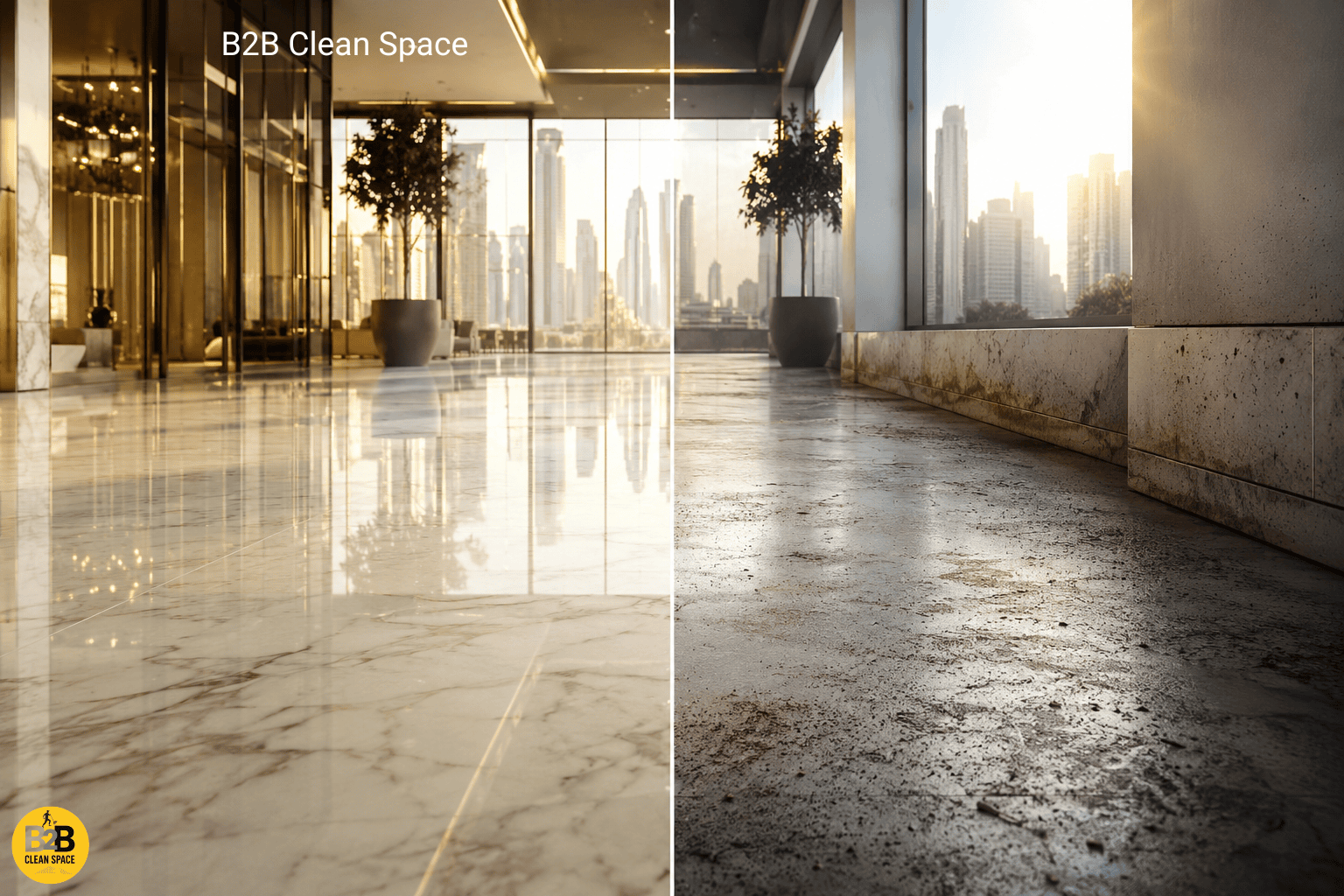
In Dubai, interiors do not age only with time. Sometimes, just a few weeks of daily use are enough for a space to lose its fresh, polished look.
The reason is not always poor-quality finishing, cheap materials, or careless visitors. One of the biggest factors is fine dust and sand that enter the premises every day, almost unnoticed.
You may not see them immediately. But they are often exactly what makes an interior look less premium.
Dust Does More Than Sit on Surfaces — It Changes the Way a Space Feels
Every space has its own visual “freshness signal”: the shine of the floor, clean glass lines, neat skirting boards, consistent furniture colour, and details free from grey dust buildup.
When a thin layer of dust appears, people may not immediately understand what feels wrong. But the impression changes. The interior starts to look less new, less cared for, and less high-end.
This is especially important for commercial spaces — offices, lobbies, showrooms, salons, clinics, hotels, and restaurants. In these environments, clients judge not only the service, but also the space around them.
Sand Works Quietly — and Can Cost More Than You Think
Sand is not just dirt near the entrance. Underfoot, it acts like a fine abrasive. Every step slightly scratches the surface. Once, it is invisible. Thousands of footsteps a day — and the floor gradually loses its shine.
First, the surface becomes dull. Then it starts to look old, even after cleaning. At some point, the space no longer looks dirty — it looks worn.
That is much more serious for a business. Dirt can be removed quickly. A worn appearance often requires polishing, deep cleaning, repair, or even replacement of materials.
The Biggest Problem Is Not Always the Dirt You Can See
Visible dirt is usually dealt with quickly: marks near the entrance, stains on the floor, litter, or smudges on glass. These are clear and obvious.
But interiors are often damaged by what builds up quietly:
dust in corners and along skirting boards, a grey film on glass partitions, sand trapped in carpeted areas, dirt around entrances, and particles settling into furniture and textiles.
These small details create the feeling that the space is no longer as fresh as it used to be.
Why Regular Cleaning May Not Be Enough
Simply washing the floor and wiping surfaces may not stop an interior from losing its appearance quickly. The key is not only to remove dust, but to control how it moves through the property.
This requires well-managed entrance areas, regular attention to high-traffic zones, and proper care for glass, skirting boards, carpets, upholstered furniture, and hard-to-reach areas.
In this sense, professional cleaning is not just about making a space clean today. It is about helping the premises keep their new, polished, well-maintained look for longer.
Cleanliness Is Part of the Value of an Interior
Fit-out, furniture, glass, flooring, and textiles are a serious investment. Without proper care, they lose their visual value much faster.
Dust and sand rarely create a dramatic problem in one day. They work slowly, which is why they are often underestimated.
But for a client, tenant, guest, or business partner, the difference is instantly noticeable: one space feels fresh and well-managed, while another feels tired — even if it was renovated not long ago.
An interior does not age only because of time. Sometimes, it ages because dust has been allowed to become part of the space.